01
Technology
Developing and protecting process know-how and intellectual property around the conversion of chemically organic feedstocks into useful energy and carbon products.

Clean Energy Enterprises develops technologies and projects that transform difficult organic waste streams into hydrogen, concentrated CO₂ and new pathways for local, circular value creation.
Technology ownership, project development and deployment across North America, Europe, Asia and selected international markets.
Clean Energy Enterprises Inc. is the parent company of Ways2H. CEE manages the group's strategic development and supports the creation of waste-to-value projects. Clean Energy Enterprises SAS, established in France, supports European and selected international activities.
Developing and protecting process know-how and intellectual property around the conversion of chemically organic feedstocks into useful energy and carbon products.
Through Ways2H, engineering and supplying modular conversion systems, from the 1 dry-ton-per-day CRU to standard 24 dry-ton-per-day commercial modules.
Developing customer-owned system sales as well as selected Build-Own-Operate opportunities where project economics and local conditions support long-term asset ownership.
CEE's strategy is built around distributed infrastructure: use difficult waste streams close to where they arise, produce hydrogen close to where it is consumed, and treat concentrated CO₂ as a separable product stream rather than simply releasing it.
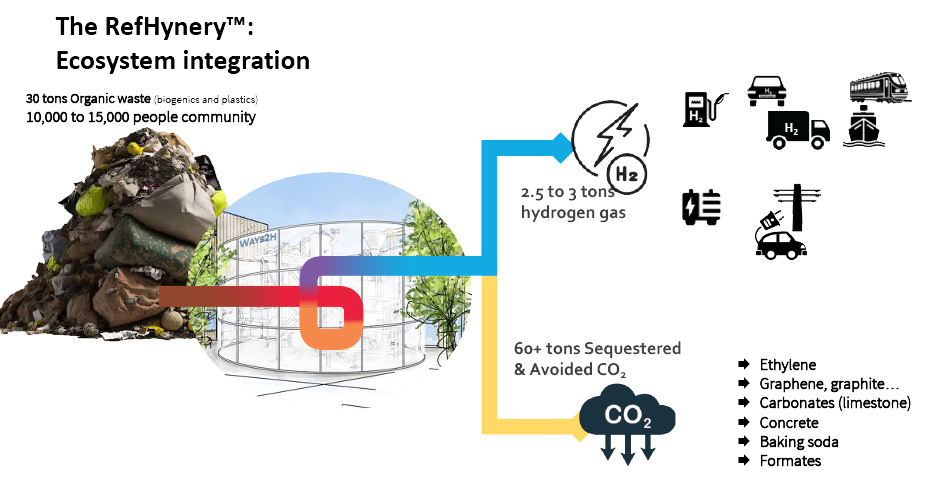
Ways2H, a wholly owned subsidiary of CEE, engineers and supplies a modular thermochemical Platform designed for chemically organic feedstocks including plastics, RDF, textiles, biomass, forestry residues and suitably preprocessed organic waste.
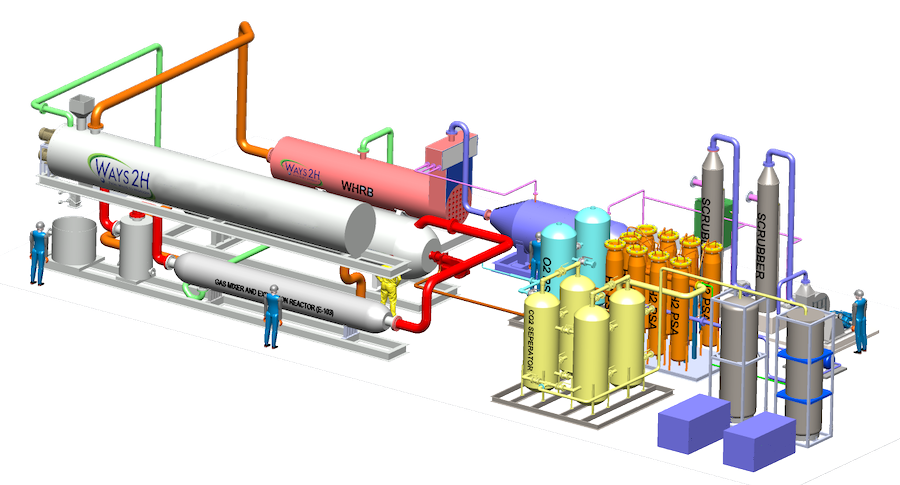
The Platform combines commercially established industrial unit operations in a proprietary process architecture. Feedstock passes through the Vapolyser and high-temperature Reformer in a steam-rich atmosphere. A fraction of the produced hydrogen is combusted with oxygen to provide controlled process heat, avoiding combustion by-products in the process gas.
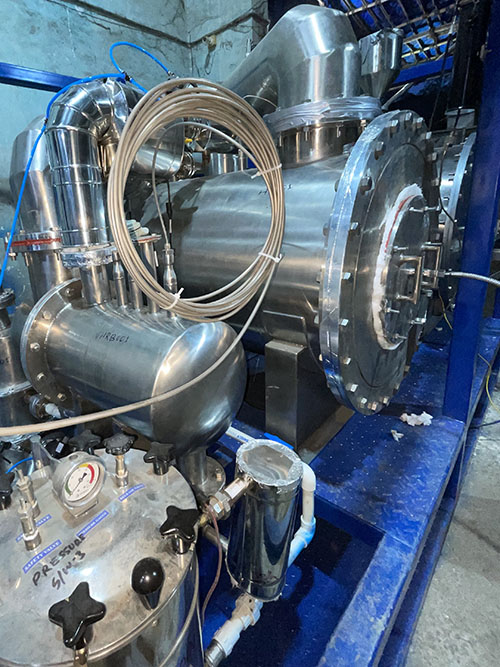
The core process has been developed through engineering and testing, while the broader system integrates established industrial equipment for gas cleaning, water-gas shift, separation, compression and balance-of-plant functions. The 1 dry-tpd Certification Reference Unit is intended to provide integrated operational validation and a working demonstration for customers, partners and public stakeholders.
The optimal configuration depends on feedstock, site, permitting, hydrogen demand, energy prices and the available route for CO₂. CEE evaluates those variables at Project Assessment stage rather than applying a single cookie-cutter business case.
Target residual organic and carbonaceous streams that are otherwise difficult to recycle or recover economically.
Supply local mobility, industrial users, fuel cells or other applications without relying solely on electricity-intensive electrolysis.
Where appropriate, couple hydrogen production with fuel cells to create dispatchable electricity from locally available waste resources.
Evaluate sequestration and utilization pathways such as mineralization, carbonates, chemicals, greenhouse use or carbon-material production according to local economics.
CEE and Ways2H work with waste companies, municipalities, industrial users, energy companies, project developers and strategic investors to assess projects from feedstock through product offtake.
Jean-Louis Kindler, CEO
+1 (323) 373-5844
+33 6 87 19 95 27
 LinkedIn